


SEO Agency: How to Choose the Right One for Your Business
Quick Summary
Choosing an SEO agency isn’t just about promises-it’s about feeling confident in their process, reporting, and fit with your business. This guide explains what an SEO agency should do, how much it may cost in the UK and USA, which services matter, and how to avoid common mistakes. It aims to make business owners, marketing managers, ecommerce teams, and startups feel assured when comparing local, national, or international support.
Key Points
- An SEO agency should improve visibility through technical fixes, content, links, and measurement.
- Best for: businesses that need consistent execution, not one-off advice.
- Avoid: guaranteed rankings, vague deliverables, and reports that only show impressions.
- Knowing the typical cost range-from £500 to £5,000+ / $600 to $6,000+ per month, and audits often costing £650 to £2,500 / $800 to $3,000-helps you feel prepared and confident in setting realistic expectations when selecting an SEO agency.
Everything You Should Know
When your site gets traffic but not enquiries, understanding that the problem may be structure, intent, or trust-not just content-should reassure you. A good SEO agency will audit fundamental technical issues like crawling, indexation, and page speed first, giving you confidence in tackling core problems before moving forward.
This guide covers how to evaluate SEO agency services, compare local SEO agency options near you, and judge ecommerce SEO agency, B2B SEO agency, SaaS SEO agency, healthcare SEO agency, and technical SEO agency offers. It also covers budget tiers, tools, common mistakes, and UK vs USA differences.
What is an SEO Agency?

An SEO agency is a partner that helps your pages appear for relevant searches on Google and, where useful, Bing. The work usually sits in four layers: technical SEO, on-page optimisation (optimization), content, and off-page authority such as digital PR or ethical link earning.
As of 2026, Google’s helpful content guidance and spam policies still reward people-first pages, clear information, and trustworthy sources. That means an agency should not only chase keywords. It should improve search intent match, page experience, schema markup where relevant, and measurement through Google Search Console and Google Analytics 4.
For UK businesses, an SEO agency UK should understand British spelling, local packs, GBP categories, and GDPR. For US businesses, expect emphasis on Google Business Profile, reviews, CCPA or state privacy rules, and higher competition in large metro markets.
The Strategy Process Breakdown
- Technical discovery
Crawl the site, review indexation, redirects, canonicals, XML sitemaps, pagination, mobile usability, and Core Web Vitals. - Keyword and intent mapping
Group keywords by intent: informational, commercial, transactional, and local. Map each cluster to one primary URL to avoid cannibalisation (cannibalization). - On-page and content improvements
Rewrite titles, headings, internal anchors, and thin copy. Add schema, FAQs, and proof where appropriate. - Authority and measurement
Build digital PR, partnerships, and useful resources. Report rankings, clicks, conversions, and revenue, not just domain metrics.
Quick Reference Table
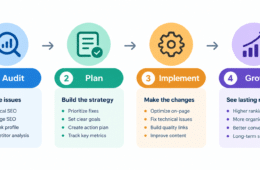
Table
| Stage | Action | Expected Outcome |
| Audit | Crawl, analytics, GSC review | Issues list with priority and owner |
| Strategy | Intent map and page plan | Clear targets for each page |
| Build | Content and technical fixes | Better relevance and crawl efficiency |
| Growth | Links, PR, CRO | More qualified organic traffic |
How to Implement the Right Fit
Scenario 1: Local service business needing calls
Who: plumber, dentist, solicitor, or clinic.
Problem: “seo agency near me” searches are crowded, and reviews are weak.
Solution: choose a local SEO agency that audits GBP, categories, services, reviews, location pages, and local schema.
Step-by-step: fix NAP consistency, build service pages per location, request reviews ethically, track calls and direction requests.
Tools: Google Search Console, Google Business Profile, BrightLocal, Screaming Frog.
Timeframe: 3 to 6 months for steadier local visibility.
Scenario 2: Ecommerce store with thin category pages
Who: fashion, homeware, or supplements retailer.
Problem: products rank, categories do not.
Solution: use an ecommerce SEO agency to improve faceted navigation, canonical rules, breadcrumbs, product schema, and internal links from blog to category.
Tools: Screaming Frog, Ahrefs, SEMrush, Surfer SEO.
Timeframe: technical fixes 2 to 8 weeks; category gains often 4 to 9 months.
Scenario 3: B2B or SaaS company chasing demos
Who: software or professional services firm.
Problem: traffic is broad, and sales calls are low quality.
Solution: pick a B2B SEO agency or SaaS SEO agency that ties pages to pipeline, uses comparison pages, integration pages, and bottom-funnel FAQs.
Tools: Google Analytics 4, HubSpot or Salesforce, Ahrefs, Moz.
Timeframe: 6 to 12 months for compounding returns.
Best SEO Agency Tools and Services: Our Top Picks
- Google Search Console
Price: Free. Available in: UK / USA / Both (online).
Best for: indexing, queries, page performance, and Core Web Vitals reports.
Why it works: it is first-party data from Google.
Honest downside: it shows what happened, not always why.
How to use: verify the domain, submit sitemaps, review coverage and page experience weekly. - Ahrefs
Price: from about £79 / $99 per month. Available in: Both (online).
Best for: backlinks, keyword gaps, and competitor content.
Why it works: strong link index and clear competitor comparison.
Honest downside: costs rise quickly for multiple users.
How to use: run a site audit, then compare competing URLs by traffic and referring domains. - SEMrush
Price: from about £108 / $130 per month. Available in: Both (online).
Best for: keyword research, PPC context, and position tracking.
Why it works: broad workflow for agencies and in-house teams.
Honest downside: can feel noisy if you want only SEO.
How to use: build a project, track branded and non-branded terms, export cannibalisation reports. - Screaming Frog SEO Spider
Price: free up to 500 URLs; licence about £259 / $319 per year. Available in: Both (online and desktop).
Best for: technical crawls, redirects, metadata, and hreflang checks.
Why it works: fast, detailed, and practical for technical SEO agency work.
Honest downside: desktop software, not a full outreach or content suite.
How to use: crawl the site, filter errors, and prioritise by template and page value. - PageSpeed Insights
Price: Free. Available in: Both (online).
Best for: Core Web Vitals, lab data, and field data.
Why it works: simple bridge between developer and marketer.
Honest downside: a score alone will not fix business impact.
How to use: test key templates, then share fixes with developers and retest.
UK vs USA SEO Differences
UK searchers often use “near me”, town names, and British spelling, so an SEO agency UK should optimise (optimize) for “colour”, “optimisation”, “organisation”, and local modifiers. US campaigns may target larger cities, more review competition, and state-level privacy considerations. Prices in the US are often higher for competitive metros, while UK retainers may be lower outside London. GDPR matters in the UK and EU; CCPA and similar state laws matter in parts of the USA. Local SEO still depends on GBP quality, reviews, relevance, and distance.
Common Mistakes to Avoid
Don’t: Buy only “DA links”. Do: Earn relevant mentions.
Why it is a mistake: a high metric can still bring in no customers. Better approach: digital PR and digital PR tools such as Ahrefs or BuzzStream.
Why it works: relevant referral traffic can support rankings and brand search.
Don’t: Ignore technical basics. Do: Fix crawl and indexation first.
Better approach: Screaming Frog plus Search Console. Why it works: pages that cannot be crawled cannot rank.
Don’t: Let one page target every keyword. Do: Map intent to URLs.
Better approach: SEMrush or Ahrefs keyword lists. Why it works: clearer intent usually improves click-through rate.
Don’t: Judge by impressions alone. Do: Track conversions and revenue.
Better approach: Google Analytics 4 with events and key events configured. Why it works: organic sessions do not pay invoices.
Don’t: Publish thin AI copy at scale. Do: Add experience, proof, and editorial review.
Better approach: human-edited briefs using Surfer SEO for structure only. Why it works: Google’s people-first guidance rewards useful pages.
Budget Guide: Every Price Point
Under £50 / $50:
Do your own foundation: claim GBP, install Google Analytics 4, verify Search Console, fix titles, and collect reviews. Free tools are enough for the basics.
£50 to £150 / $50 to $150:
Use one paid tool such as Ahrefs, SEMrush, Moz, or Surfer SEO, plus freelance help for technical fixes or content editing. Best value: a focused audit rather than a broad retainer.
£150+ / $150+:
Best for competitive ecommerce, healthcare, SaaS, multi-location, or enterprise SEO agency needs. Spend more when you need strategy, development tickets, digital PR, content production, and clear reporting.
Prices may vary by niche, location, and scope. Prices checked: September 2026.
Seasonal Notes
Summer often brings travel, outdoor, wedding, and local service searches. Winter can lift ecommerce, gifting, finance, and healthcare appointments around New Year. In the UK, weather can shift demand quickly for trades, events, and retail, so review Search Console weekly. In the US, use regional seasonality: hurricane prep, back-to-school, Black Friday, and tax season can change intent by state.
What to Do for Specific Business Types
Local business:
Prioritise Google Business Profile, reviews, location pages, local schema, and consistent citations. Works well because proximity and relevance influence the local pack.
Ecommerce store:
Control faceted navigation, canonicals, product schema, breadcrumbs, and internal linking from guides to categories. Works well because category pages often carry commercial intent.
B2B or service business:
Build comparison pages, use-case pages, integration pages, case studies, and bottom-funnel FAQs. Works well because longer sales cycles need trust at every stage.
Frequently Asked Questions
Q: What does an SEO agency do?
A: An SEO agency audits technical health, researches keywords, maps intent, improves on-page content, earns relevant authority, and reports on traffic and conversions. A credible one should explain trade-offs and avoid ranking guarantees.
Q: How much should an SEO agency cost?
A: Small local projects may start around £500 to £1,000 / $600 to $1,200 per month. Competitive ecommerce, SaaS, healthcare, or enterprise work often runs £2,000 to £5,000+ / $2,500 to $6,000+ per month. Audits commonly cost £650 to £2,500 / $800 to $3,000.
Q: Should I choose a local SEO agency near me?
A: If customers come from your area, local expertise matters. Check whether the agency understands Google Business Profile, reviews, service-area pages, local schema, and call tracking. Location matters less for national or international campaigns.
Q: How long until SEO works?
A: Technical fixes can show impact in weeks, but meaningful organic growth usually takes 4 to 12 months depending on competition, site history, content quality, and authority. Be cautious with any promise of instant results.
Q: Is SEO different in the UK and USA?
A: The core principles are similar. Differences include spelling, local modifiers, privacy rules, review competition, pricing, and market size. UK campaigns often need tighter local targeting; US campaigns may need state or city segmentation.
Q: I am new to SEO. Where do I start?
A: Verify Search Console and Google Analytics 4, confirm indexing, set up Google Business Profile, fix page titles, improve your five most valuable pages, and track calls or enquiries. Keep changes small and measurable.
Q: Agency vs DIY: which is better?
A: DIY can work for simple local sites if you have time. Choose an agency when you need technical development, content operations, digital PR, and consistent reporting across many pages. Ask for a pilot project before a long contract.
Q: Does SEO work for small businesses?
A: Yes, especially when intent is local and specific. A small firm can win with clear service pages, reviews, fast pages, useful FAQs, and consistent contact details. Avoid copying large competitors page for page.
Final Action Notes
Start with the pages that already get impressions, then improve intent match, internal links, and proof. A solid SEO agency should make the next 90 days obvious: what will be fixed, who owns it, what it costs, and how success is measured. If your market is local, prioritise Google Business Profile and reviews. If you sell online, prioritise category architecture and technical controls. If you are B2B, tie content to pipeline.
Worth exploring next: local SEO for service businesses, ecommerce SEO audits, and technical SEO checklists for growing sites. Please share your website and target location, and I can suggest the first ten actions to discuss with an agency.
Related guides: Before choosing a provider, compare the core SEO ranking factors, our Ranker SEO process, and the risks involved in buying backlinks for SEO.