

30
Aug, 2026
SEO Ranking Factors: A Practical Guide for Agencies
Quick Summary:
This guide breaks down the SEO ranking factors that matter most in 2026 — technical, on-page, and off-page — and how to explain them to clients without exaggerating. It’s written for agencies managing multiple client sites who need clear reporting frameworks, not just a list of Google’s supposed 200 signals.
Key Points
- SEO ranking factors are the signals Google’s algorithm weighs to decide where a page sits in results — split into technical, on-page, off-page, and content quality.
- Best for: agencies needing a client-facing framework, not a technical audit checklist.
- Avoid: treating every “ranking factor” list you find online as gospel — many are outdated or unverified.
- Typical cost range for a proper ranking factor audit: £150-£400 / $190-$500 depending on site size.
Everything You Should Know

Clients ask “why isn’t my site ranking?” more often than any other question, and the honest answer is usually “numerous factors, not one.” Explaining SEO ranking factors clearly — without resorting to technical language or vague reassurance — is part of the job when you’re managing accounts on their behalf.
This guide covers what’s confirmed to matter, what’s speculative, and how to structure a report your client will actually understand. Google doesn’t publish a definitive ranking factor list, and any agency claiming certainty here is overstating what’s known. This way helps you set realistic expectations while still demonstrating expertise.
What is an SEO Ranking Factor?
An SEO ranking factor is any signal Google’s algorithm uses to evaluate and order search results. These fall into four broad categories: technical health (crawlability, site speed, Core Web Vitals), on-page signals (content pertinence, search intent match, internal linking), off-page signals (backlinks, brand mentions), and content quality (depth, accuracy, EEAT — experience, expertise, authoritativeness, trustworthiness).
Google has confirmed some factors directly through Search Central documentation — page experience, helpful content, and structured data among them. Others, like exact “domain authority” scores, are third-party metrics (Moz’s own metric) rather than something Google itself uses.
As of 2026, Google’s algorithm prioritizes helpful, people-first content alongside technical fundamentals — meaning a technically flawless site with thin content still underperforms. For agencies, this means off-page SEO ranking features such as backlinks matter less in isolation than they did five years ago; they work best alongside genuine content depth and topical relevance.
UK and US clients often ask about this differently — UK clients tend to ask about “Google rankings” broadly. In contrast, US clients more often name specific competitors and ask for direct comparison.
The Ranking Factor Audit Process
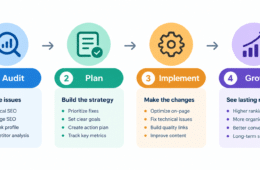
- Technical baseline — Run a crawl (Screaming Frog or similar) to catch indexing issues, broken links, and crawl budget waste before touching anything else.
- On-page review — Check search intent match, title tags, header structure, and internal linking against top-ranking competitors.
- Off-page assessment — Audit the existing backlink profile for toxic links, then identify realistic link-building opportunities (guest content, digital PR, resource pages).
- Content gap analysis — Compare client content depth against ranking competitors using a tool like Ahrefs or SEMrush to find missing subtopics.
More detailed audits (5-6 steps, adding schema markup review and Core Web Vitals deep-dives) suit larger or more competitive sites, but keep each step something you can action and report on — a step that only produces data with no next action isn’t worth a client’s time.
Quick Reference Table
Stage | Action | Expected Outcome |
| Technical audit | Crawl site, fix indexing/speed issues | Removes barriers Google needs cleared before content can rank |
| On-page optimization | Align content with search intent, fix headers | Improves relevance signals for target queries |
| Off-page building | Earn backlinks from relevant, real sites | Builds authority signals over 3-6 months |
| Content refresh | Expand thin pages, update outdated stats | Addresses helpful-content quality signals |
How to Implement This for Client Sites
Scenario 1: New Client Onboarding Audit
- Who: A mid-sized e-commerce client new to the agency
- Problem: No prior SEO reporting, unclear why traffic has plateaued
- Solution: Run a full ranking factor audit (technical, on-page, off-page) and present findings as a prioritized action list, not a wall of metrics
- Tools: Screaming Frog, Google Search Console, Ahrefs
- Timeframe: 1-2 weeks for the audit, ongoing monthly reporting after
Scenario 2: Describing a Ranking Drop
- Who: An existing B2B client who saw a sudden ranking drop
- Problem: Client assumes it’s a penalty; it’s actually a competitor’s content update plus a Core Web Vitals regression
- Solution: Pull historical rank data, isolate the timing against known algorithm updates, and separate “what changed on their site” from “what changed inside the competitive landscape”
- Tools: Google Search Console, PageSpeed Insights, a rank tracker like SEMrush
- Timeframe: 2-3 days to diagnose, explain in the next scheduled report.
Scenario 3: White-Label Reporting for a Reseller Client
- Who: An agency partner reselling your SEO services under their own brand
- Problem: They need client-ready ranking factor reports without your agency’s name on them
- Solution: Build a white-labelled reporting template covering the identical technical/on-page/off-page breakdown, branded for the reseller
- Tools: Looker Studio (connected to Search Console and Analytics data), or built-in white-label reporting from Ahrefs/SEMrush
- Timeframe: Template setup takes 3-5 hours once; monthly refresh after is quick
Best Tools for Tracking Ranking Factors — Our Top Picks
1. Google Search Console
- Price: Free
- Available in: Both (online)
- Best for: Confirming indexing status and real click/impression data
- Why it works: It’s Google’s own data, not a third-party estimate.
- Downside: Limited historical data (16 months) and no competitor comparison
- How to use: Check the Performance and Coverage reports weekly for client sites.
2. Ahrefs
- Price: £79-£799 / $99-$999 per month depending on tier
- Available in: Both (online)
- Best for: Backlink analysis and competitor ranking factor comparison
- Why it works: Large, frequently updated backlink index
- Downside: Pricing scales quickly for agencies managing many sites
- How to use: Use the Site Explorer to audit a client’s backlink profile against 2-3 competitors.
3. Screaming Frog
- Price: Free (up to 500 URLs) / £149 / $185 per year for full license
- Available in: Both (downloadable software)
- Best for: Technical crawl audits — broken links, redirect chains, duplicate content
- Why it works: Fast, detailed, and doesn’t rely on sampled data like some cloud crawlers.
- Downside: Requires local install and some technical familiarity to interpret results fully
- How to use: Run a full crawl before every client audit to catch technical ranking factor issues first.
4. Moz
- Price: £79-£399 / $99-$499 per month
- Available in: Both (online)
- Best for: Domain Authority tracking and keyword ranking reports for client presentations
- Why it works: Domain Authority, while not a Google metric, is widely understood by clients as a shorthand for site strength.
- Downside: DA is Moz’s proprietary metric, not something Google uses directly — worth clarifying this to clients so it isn’t mistaken for an official Google score
- How to use: Include DA trend charts in monthly reports alongside actual ranking positions
5. SEMrush
- Price: £109-£449 / $139-$559 per month
- Available in: Both (online)
- Best for: Combined rank tracking, competitor analysis, and white-label PDF reporting
- Why it works: Built-in white-label reporting saves agencies hours on manual report building.
- Downside: The interface has a steep learning curve for new team members
- How to use: Set up automated weekly rank tracking reports for each client, branded with your agency logo.
UK vs USA SEO Differences
UK clients tend to have smaller local search volumes, meaning ranking factor changes show up more slowly in visible traffic shifts than in the US, where higher search volume makes fluctuations more obvious sooner. US clients more frequently ask about local maps ranking for multi-location businesses, given the scale of US metro areas.
Pricing conversations differ too — UK clients often expect monthly retainer pricing in round £ figures, while US clients are more accustomed to tiered packages. GDPR affects how UK/EU agencies can use certain analytics and tracking tools; US agencies operate under different (currently less centralized) data privacy rules, though this is shifting state by state.
Common Mistakes to Avoid
Don’t: Chase every “ranking factor” listicle you find online.
Do: Rely on Google’s own Search Central documentation as the primary source.e
Why it’s a mistake: Many popular “200 ranking factors” lists mix confirmed signals with conjecture, a few outdated since 2018.
Better approach: Google Search Central — Free
Why it works: It’s the only source Google itself maintains and updates.
Don’t: Promise clients a specific ranking position.
Do: Report on trend direction and the factors being addressed.
Why it’s a mistake: No agency controls Google’s algorithm; a “guaranteed #1 ranking” promise is unenforceable, and damages trust when unmet.
Better approach: Monthly rank tracking via SEMrush or Ahrefs — £79-£449 / $99-$559
Why it works: Shows honest movement over time rather than a single unverifiable claim.
Don’t: Skip the technical audit and jump straight to content.
Do: Fix crawlability and Core Web Vitals issues first.
Why it’s a mistake: Great content on a slow, poorly indexed site still underperforms.
Better approach: Screaming Frog — Free/£149 / $185 per year
Why it works: Surfaces technical blockers before time is spent on content that won’t get crawled properly.
Don’t: Treat Domain Authority as a Google ranking factor.r
Do: Explain DA to clients as a comparative third-party metric.
Why it’s a mistake: Clients sometimes fixate on raising DA specifically, which isn’t a signal Google uses directly.
Better approach: Moz with clear client-facing explanation — £79-£399 / $99-$499
Why it works: Keeps client expectations aligned with what actually moves rankings.
Don’t: Build backlinks from irrelevant or low-quality sites.
Do: Prioritize fewer, more relevant links over volume.
Why it’s a mistake: Google’s algorithm has repeatedly targeted manipulative link schemes; irrelevant links can be flagged as unnatural.
Better approach: Ahrefs backlink audit — £79-£799 / $99-$999
Why it works: Identifies existing toxic links and surfaces realistic, relevant opportunities instead.
Budget Guide — Every Price Point
Under £50 / $50:
- Focus on: Technical fixes and manual Search Console monitoring.
- Recommended tools: Google Search Console (free), PageSpeed Insights (free), Screaming Frog free tier
£50-150 / $50-150:
- Shop at: Mid-tier plans on Moz or entry-level SEMrush
- Best value: SEMrush’s lower tier for combined tracking and reporting on several of client sites
£150+ / $150+:
- Best for: Agencies managing 10+ client sites needing white-label reporting and deep competitor data
- Why spend more: Time saved on manual reporting and more comprehensive backlink/competitor data usually pays for itself in agency hours
Seasonal Notes
Retail and e-commerce clients typically see ranking factor volatility increase before major shopping periods, as competitors refresh content and build links ahead of peak search volume. Agencies should schedule technical audits well before these windows, not during them.
UK seasonal note: Boxing Day sales content should be optimized and indexed by late November — Google needs time to crawl and rank new pages.
US seasonal note: Black Friday and Cyber Monday pages benefit from being live (not just planned) at least 4-6 weeks ahead of the date for indexing time.
What to Do for Specific Business Types
Local Business:
- Focus on Google Business Profile optimization alongside on-page factors, plus local citation consistency.
- Why it works: Local ranking factors weigh proximity and relevance signals differently than national organic results.
E-commerce Store:
- Prioritise product page schema markup, site speed (Core Web Vitals), and duplicate content management across variants.
- Why it works: E-commerce sites commonly struggle with thin or duplicate product descriptions, a common ranking factor weakness.
B2B/Service Business:
- Focus on topical authority through in-depth content clusters and earning industry-relevant backlinks.
- Why it works: B2B search intent tends to be research-heavy, rewarding depth over volume of pages.
Frequently Asked Questions
Q: What are SEO ranking factors?
A: SEO ranking factors are the signals Google’s algorithm uses to determine page order in search results — including technical health, content pertinence, backlinks, and page experience. No single factor guarantees a position; it’s the combination that matters.
Q: How much does an SEO ranking factor audit cost?
A: A standard audit typically runs £150-£400 / $190-$500 depending on site size and complexity. Larger e-commerce sites with more pages to crawl and assess sit at the higher end of that range.
Q: What’s the best tool for tracking SEO ranking factors?
A: It depends on the need — Google Search Console (free) for real click data, Ahrefs or SEMrush for competitor and backlink analysis, and Screaming Frog for technical crawl audits. Most agencies use a combination.
Q: How long does it take to see ranking improvements?
A: Typically 3-6 months for noticeable movement after addressing ranking factors, though this varies by competition level and how significant the existing issues were. Anyone promising faster guaranteed results should be treated with caution.
Q: Are SEO ranking factors different in the UK vs the US?
A: The fundamental factors are the same globally, but search volume, competition, and local search behaviour differ. US local searches frequently involve more competitors per query given larger metro populations; UK searches show ranking shifts more distinctly given lower volume.
Q: I’m new to SEO — where should I start with ranking factors?
A: Start with a free Google Search Console account and a crawl using Screaming Frog’s free tier to spot technical issues. Fix crawlability and indexing problems before focusing on content or backlinks.
Q: Should agencies handle SEO in-house or use white-label services?
A: This depends on team capacity and expertise. White-label reporting tools (built into SEMrush and Ahrefs) let smaller agencies offer full ranking factor reporting without building everything from scratch.
Q: Does SEO ranking factor optimization work for small businesses?
A: Yes, though expectations should scale with budget and competition. A local bakery competing for local search terms faces far less competition than a national e-commerce brand, meaning ranking factor improvements often show results sooner.
Final Action Notes
SEO ranking factors aren’t a fixed checklist — they’re a set of technical health, on-page relevance, off-page authority, and content quality that shifts as Google’s algorithm evolves. For agencies, the value is less in memorizing every factor, and more in building a repeatable audit and reporting process clients can understand.
Worth considering: pairing this ranking factor framework with a white-label reporting template and a rank tracking dashboard so clients see progress without needing the technical detail explained every month. Related topics worth exploring next: local SEO ranking factors for maps visibility, and building an SEO ranking report template that scales across multiple client accounts.
Related guides: For practical application, see our guides to building backlinks, link building SEO, and selecting an SEO agency.